
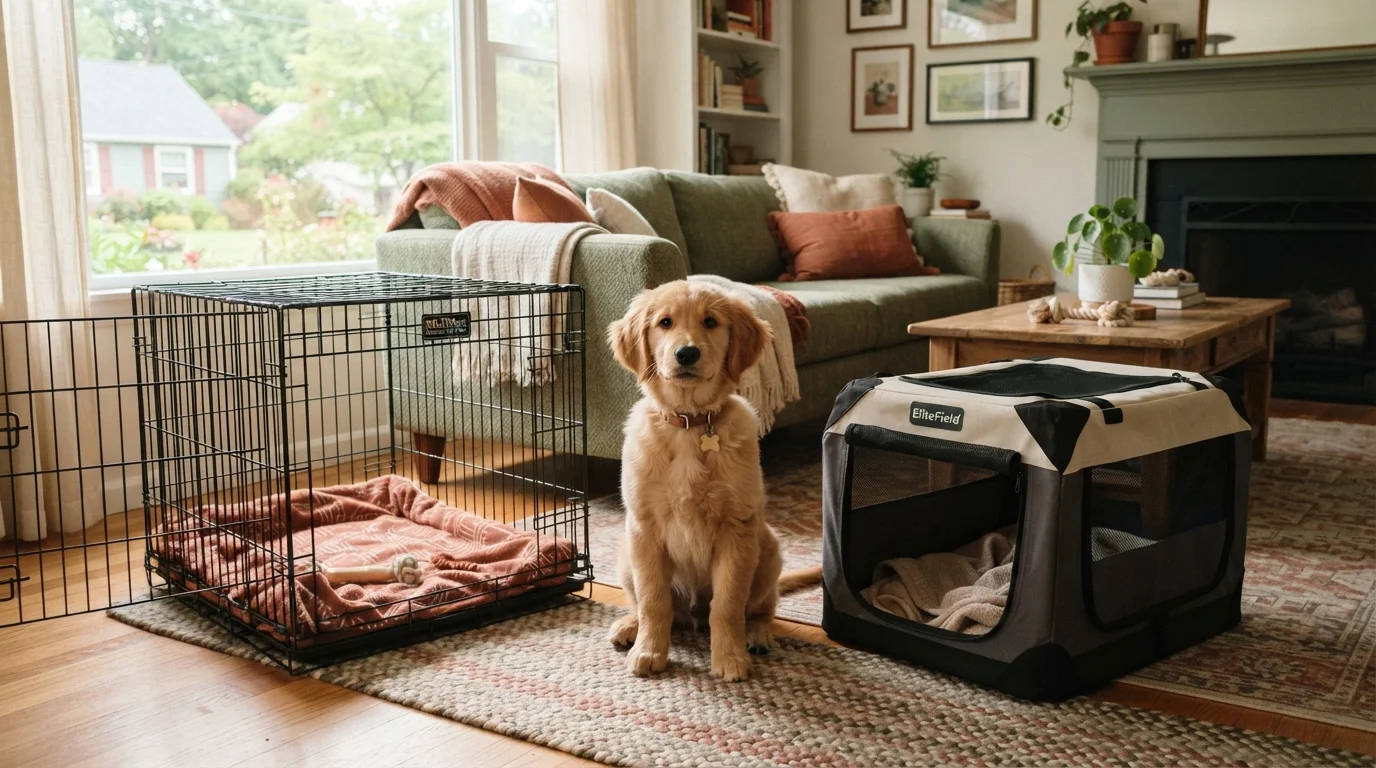
Travel Crate vs Home Crate: Which One Does Your Puppy Actually Need?
You’ve finally mastered the bedtime routine, and your puppy is sleeping peacefully in their sturdy wire crate in the corner of your living room. But now, a weekend road trip, a cross-country flight, or a routine vet appointment is looming on your calendar. Standing in your hallway, you look at that heavy, awkward home crate and wonder: can you just disassemble it for the trip, or do you need to buy a separate travel option? Navigating gear choices for a new puppy can feel like an expensive guessing game, especially when you are trying to keep your dog safe and comfortable without turning your suburban apartment or garage into a pet supply warehouse.
Understanding the differences between a travel crate vs home crate helps you make a practical purchase that saves you money and prevents training setbacks. In this guide, you will learn how home and travel crates differ in safety, durability, and puppy psychology, along with clear guidance on when you need each type. Whether you are prepping for a cross-country move or trying to establish a reliable nap schedule, choosing the right setup ensures your puppy stays secure at home and on the road.
Why Your Puppy’s Crate Setup Matters More Than You Think

A crate is not just a metal box; it is your puppy’s primary sanctuary during the overwhelming transition into a new home. When you first bring a puppy home, establishing a predictable environment is vital for house-training and managing anxiety. However, treating all crates as interchangeable tools is a common mistake that can derail your progress.
Engineers design a home crate for stationary security, daily containment, and chew resistance. In contrast, they design a travel crate for mobility, impact distribution, and compact storage. When you use the same heavy home crate for travel, you often risk scratching your car interior, struggling with awkward assembly in cramped parking lots, or stressing out a puppy who cannot differentiate between sleep time and transit time.
Furthermore, puppies thrive on environmental cues. If their sleeping den suddenly transforms into a moving vehicle, it can disrupt their sense of safety. Investing in the right setup for each scenario helps your puppy understand exactly what behavior is expected of them, whether they are winding down for a three-hour nap in the living room or buckling up for a drive to the local park.
Home Crates: The Heavy-Duty Standard for Daily Routine

Home crates are the anchor of your indoor puppy management system. Constructed from heavy-gauge wire, hard plastic, or heavy-duty wood, these enclosures withstand enthusiastic chewing, scratching, and daily wear and tear.
When you set up a home crate, your main priorities are ventilation, visibility, and unyielding structural integrity. Wire home crates allow maximum airflow and let your puppy watch family activity. This prevents isolation in a busy household. Plastic or wooden variants offer a den-like, enclosed atmosphere that can help anxious puppies settle down faster.
However, home crates come with distinct trade-offs. They are heavy, cumbersome to move from room to room, and entirely unsuited for safe vehicle transport unless specifically anchored. Wedging a bulky 42-inch wire crate into a sedan’s back seat causes frustration and creates danger if it shifts during a sudden stop.
- Best uses: Overnight sleeping, daytime enforced naps, and safe containment when you are cooking or working from home.
- Key advantage: Maximum durability and chew-resistance for teething puppies.
- Primary limitation: Zero portability; difficult to clean on the go and unsafe in a vehicle accident without professional tie-downs.
Travel Crates: Designed for Safety, Portability, and Transit

Travel crates are engineered for life on the move, whether you are driving across town or flying across the country. Unlike stationary home units, travel crates prioritize lightweight materials, collapsible frames, and compliance with transit safety standards.
Travel crates fall into three primary categories: airline-approved hard plastic kennels like Vari-Kennels, soft-sided fabric carriers, and crash-tested vehicle travel crates. Each serves a distinct purpose in your puppy’s transit routine. Hard plastic kennels are mandatory for cargo air travel and offer robust protection during car accidents. Soft-sided carriers are lightweight, feature mesh panels for ventilation, and fold flat for storage, making them ideal for small breed puppies riding in the passenger seat or visiting dog-friendly cafes.
The main limitation of travel crates is durability against sharp puppy teeth. A teething puppy can easily chew through the fabric of a soft-sided carrier if left unsupervised. Therefore, reserve travel crates strictly for active travel days rather than leaving them out as a primary daytime containment tool.
- Best uses: Road trips, vet visits, airline travel, and temporary containment in hotel rooms.
- Key advantage: Lightweight, easy to store, and specifically built for mobility.
- Primary limitation: Vulnerable to chewing and generally lack the heavy-duty security needed for unsupervised home use.
Safety and Crash-Testing: How They Protect Your Puppy

When evaluating a travel crate vs home crate, safety is the most critical metric. Many pet parents assume that if a crate keeps a puppy contained in the living room, it will keep them safe in a vehicle. Unfortunately, standard wire home crates can turn into dangerous hazards during a sudden stop or collision.
Wire home crates are not crash-tested. In an accident, wire panels can bend, collapse, or splinter, potentially injuring your puppy or allowing them to become a dangerous projectile inside the vehicle cabin. Furthermore, wire gaps can catch a flailing paw or jaw during sudden vehicle manoeuvres.
True travel safety requires specialized equipment. Crash-tested travel crates feature reinforced anchoring systems, heavy-duty aluminium or thick rotomolded plastic walls, and energy-absorbing construction designed to protect your dog during high-impact collisions. If you frequently travel with your puppy in the car, investing in a certified crash-tested crate or a crash-tested harness system is non-negotiable.
- Home Crate Safety: Designed to keep a puppy contained within a static room. Never use an unsecured wire crate on a vehicle seat.
- Travel Crate Safety: Built to absorb impact, secure via seatbelts or LATCH systems, and prevent the puppy from distracting the driver.
Puppy Psychology: Why Mixing Up Crate Roles Can Cause Confusion

Puppies learn through association and environmental consistency. If you use the exact same crate for daily home confinement, punishment timeouts (though discouraged, sometimes misused by owners), exciting road trips, and stressful vet visits, your puppy’s psychological association with the crate becomes muddy.
A home crate should represent a safe, predictable zone of absolute calm. When you introduce a travel crate, you create a distinct spatial boundary for adventures. This separation helps prevent travel anxiety from bleeding into your home sleep routine. If your puppy associates their cozy bedroom crate with the chaotic anticipation of a car ride, they may start fighting bedtime because they expect the engine to start.
By maintaining two distinct setups—or at least transitioning your puppy smoothly using positive reinforcement—you protect their sense of security. Let your puppy explore the travel crate in the living room with treats and praise a few days before a trip, so the first time they experience it isn’t while locked inside a moving vehicle.
Quick Comparison: Travel Crate vs Home Crate

| Feature | Home Crate (Wire / Plastic) | Travel Crate (Soft-sided / Plastic Kennel / Crash-tested) |
| Primary Purpose | Daily indoor management, sleeping, potty training | Safe vehicle transit, vet visits, travel, flights |
| Portability | Heavy, awkward, often requires disassembly | Lightweight, collapsible, or easy to carry with handles |
| Chew Resistance | Extremely high (ideal for teething puppies) | Moderate to low (soft-sided mesh can be shredded) |
| Vehicle Safety | Low (can collapse or become a projectile) | High (if crash-tested or airline-approved) |
| Setup Location | Fixed spot in bedroom, living room, or utility room | Car trunk, back seat, hotel room, airplane cabin |
Frequently Asked Questions About Puppy Crates

Can I use a soft-sided travel crate for house-training my new puppy?
No, soft-sided travel crates are generally a poor choice for primary house-training and everyday indoor use. Puppies who are still learning bladder control can easily claw or chew through fabric mesh panels when left alone, ruining the crate and creating a safety hazard. Stick to a durable wire or hard plastic crate for indoor training.
Are wire home crates safe to use in the back of an SUV?
Standard wire home crates are not designed to withstand vehicle impacts and can collapse during a sudden stop. If you transport your puppy in an SUV cargo area, you should use a dedicated, crash-tested aluminum travel crate or secure an airline-approved plastic kennel with heavy-duty tie-down straps.
How do I get my puppy used to a new travel crate?
Introduce the travel crate gradually by setting it up in your living room a week before your trip. Leave the door open, toss high-value treats inside, and feed your puppy their meals in the travel crate. Let them build a positive association with the new space before you ever zip the door or put them in the car.
Do airlines allow wire crates for puppy cargo travel?
No major commercial airlines permit wire crates for dogs traveling in the cargo hold due to safety concerns. Airlines strictly require sturdy, hard-sided plastic kennels (IATA-compliant) with metal hardware, secure ventilation holes, and a “Live Animals” label.
Should I buy a larger crate so my puppy can grow into it?
Buying an oversized crate for a tiny puppy defeats the purpose of house-training. Puppies naturally avoid soiling their sleeping quarters, but if a crate is too large, they will use one corner as a bathroom and sleep in the other. Always choose a crate size that allows your puppy to stand, turn around, and lie down comfortably, using a divider panel as they grow.
Conclusion

Choosing between a travel crate and a home crate comes down to matching the tool to the specific environment. Your heavy home crate provides the reliable, chew-proof sanctuary your puppy needs for daily rest and house-training. Meanwhile, a dedicated travel option keeps them secure, comfortable, and contained during life’s adventures on the road.


Jordan writes PuppySettled’s training and behavior guides, drawing on years of hands-on experience fostering and training rescue puppies through local shelters in Denver, Colorado. Jordan focuses on practical, force-free training methods — crate training, potty training, and the tough early behavior challenges that come with a new puppy. When not writing, Jordan’s usually out on a walk with a foster dog in training.