
7 Best Travel Crates for Puppy Owners Who Fly Often for Work
If you are standing in your hallway staring at a digital airline ticket while your new puppy chews contentedly on a shoelace, wondering how you are ever going to manage business travel with an eight-week-old dog in tow, take a deep breath. You are not failing as a pet owner, and your career doesn’t have to pause just because you brought a puppy home. When you search for the best travel crate for flying with a puppy, you are usually dealing with a high-stakes professional crunch: balancing a demanding work travel schedule with the intricate, unforgiving rules of commercial aviation.

For frequent flyers, the right travel crate depends on whether your puppy flies in-cabin or cargo. In-cabin flyers need a soft-sided, airline-specific-fitting carrier under the seat; cargo flyers need a hard-sided, IATA-compliant kennel with a single-piece metal door and secured tie-down points. No crate is universally ‘airline approved’ — always confirm with your specific airline before booking.
That final nuance is critical. Many new pet parents purchase a kennel labeled “airline approved” online, only to have a gate agent reject it because it lacks metal bolts or exceeds specific under-seat dimensions by a single inch. By understanding the strict mechanical difference between cabin and cargo setups, decoding international transport standards, and reviewing top-tier crate options, you can travel for work with absolute confidence.
Cabin vs. Cargo: Which Crate Type Do You Actually Need?

Deciding between a cabin carrier and a cargo crate depends entirely on your puppy’s adult breed size, weight, and the specific pet policies of the commercial airlines you fly for work.
Biology and airline weight limits dictate your puppy’s travel mode if you are a frequent business flyer. Most major US carriers restrict in-cabin pets to a combined weight (puppy plus carrier) of roughly 20 pounds, meaning only toy and small-breed puppies can fly under your seat.
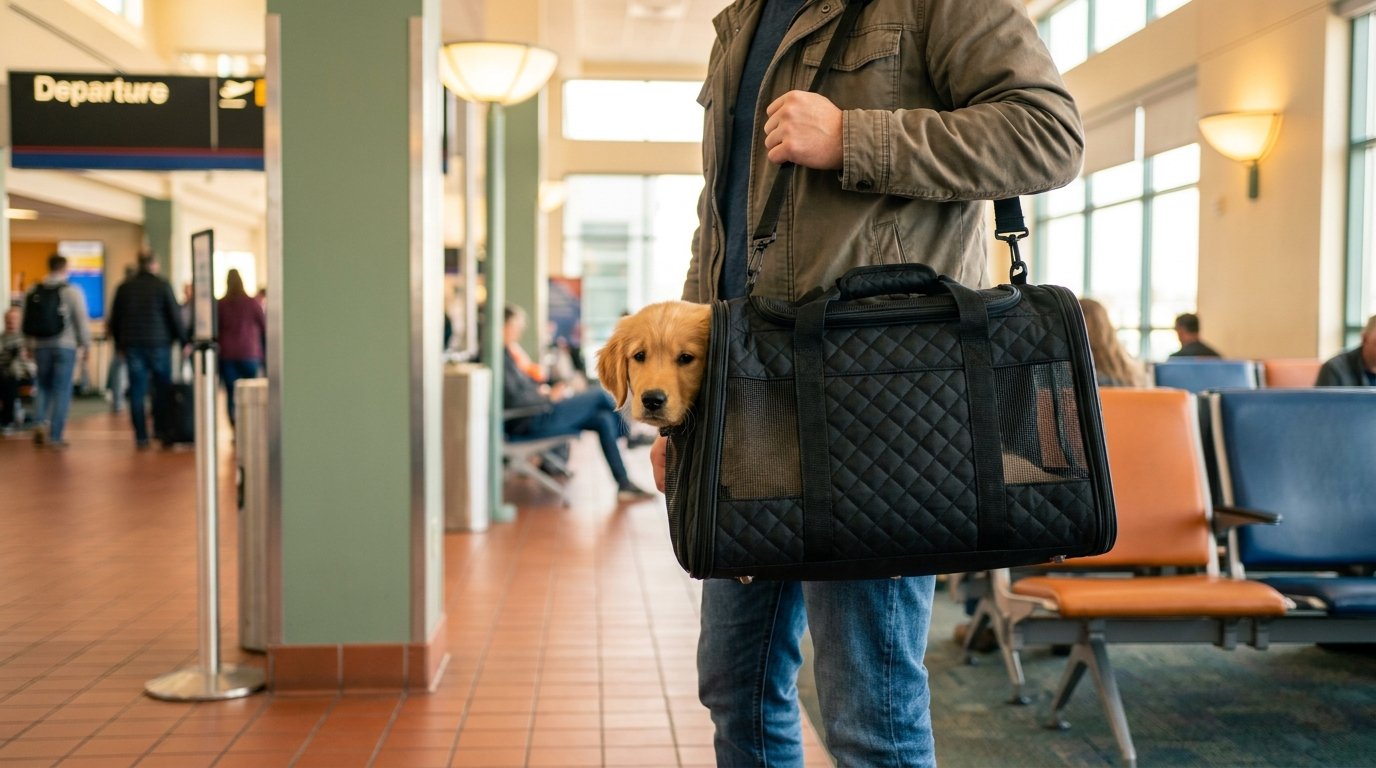
- In-cabin soft-sided carriers: These collapsible, mesh-windowed bags must flex slightly to slide under the seat ahead of you. They keep your puppy close, reduce travel anxiety, and are ideal for puppies under four to six months old who meet weight cutoffs.
- Cargo hard-sided kennels: If your puppy eventually grows into a medium or large breed, they will eventually exceed cabin weight limits and must travel in the climate-controlled cargo hold. Cargo transit requires rigorous, heavy-duty structural engineering to guarantee safety during baggage loading and flight movement.
What “IATA Approved” Really Means (and Why No Crate Is Universally Approved)

Although the International Air Transport Association provides guidelines for animal transport containers under the term “IATA approved,” individual airlines enforce their own unique dimensional and hardware variations, meaning no single crate satisfies every airline universally.
One of the most dangerous misconceptions in pet travel is assuming that an “IATA compliant” badge guarantees boarding on every airline. While IATA sets the global baseline standard for cargo crates—requiring durable plastic shells, robust ventilation, and metal hardware—every commercial airline reserves the right to enforce stricter rules.
- The plastic versus metal hardware rule: IATA standards explicitly prohibit plastic screws or latch pins on cargo crates. Every single corner and side fastener must consist of metal nuts and bolts.
- The airline verification step: Before you click purchase on any crate, visit the specific pet travel page of your preferred work airline (such as Delta, United, or American) to cross-reference their exact height, width, and length requirements.
The 7 Best Travel Crates, Ranked by Travel Frequency and Dog Size

Selecting the right travel crate requires matching its structural design to your specific work travel cadence, whether you are taking weekly regional hops in-cabin or occasional long-haul flights.
To help frequent business flyers navigate the overwhelming market, here is how the top-performing travel crates stack up across cabin and cargo categories.
| Crate Name | Cabin / Cargo | Price Tier | Best For | Key Feature |
| SturdiBag Pro (Large) | Cabin | Mid-Range | Weekly in-cabin regional flyers | Flex-rod frame collapses to fit tight under-seat spaces |
| Sleepypod Air | Cabin | Premium | Anxious small puppies on tight flights | Trolley sleeve and adjustable length dimensions |
| Petmate Sky Kennel | Cargo | Mid-Range | Standard domestic cargo transport | Heavy-duty plastic shell with 360-degree ventilation |
| Variocage Mini (Custom) | Cargo | Luxury | High-security vehicle and cargo transit | Crash-tested industrial steel framework |
| Sherpa Original Deluxe | Cabin | Budget | Occasional flyers and vet visits | Spring-wire frame and moisture-absorbing faux lambskin |
| SportPet Designs Travel Kennel | Cargo | Budget | Budget-conscious cargo transit | Metal hardware included standard out of the box |
| Pet Peppy Expandable Carrier | Cabin | Mid-Range | Extended airport layovers | Pull-out mesh side expansion for extra waiting-room space |
Best Soft-Sided Crate for Weekly Cabin Flyers

For weekly business flyers navigating tight regional jets, a high-end flexible soft-sided carrier with spring-wire framing offers the best blend of airline compliance and puppy comfort.
When you fly every week for work, efficiency through security checkpoints is everything. Soft-sided carriers are lightweight, feature convenient exterior pockets for waste bags and health certificates, and slide effortlessly beneath cramped coach seats.
- Flexibility under pressure: Unlike rigid plastic boxes, high-end soft carriers feature spring-wire or flexible fiberglass rods in their upper frames. This allows the top of the carrier to compress an inch or two to clear low under-seat clearances without collapsing inward on your puppy.
- Discreet professional travel: Sleek, black nylon carriers blend seamlessly into professional airport environments, looking more like a high-end laptop bag than a traditional pet kennel.
Best Hard-Sided Crate for Occasional Cargo Flights

For puppies growing into medium or large breeds that must travel via the cargo hold, a heavy-duty rotationally molded plastic crate with metal hardware is the gold standard.
Cargo travel demands absolute structural integrity. If your work travel requires checking your growing dog into the climate-controlled cargo hold, flimsy plastic latches will not pass inspection.
- Single-piece metal doors: Look for heavy-gauge steel wire doors with a secure, spring-loaded squeeze latch that cannot be jiggled open by a shifting puppy.
- Integrated tie-down holes: IATA-compliant cargo crates feature reinforced holes near the outer rim where airline staff can zip-tie the top and bottom halves together securely, preventing accidental separation during baggage loading.
Airline-by-Airline Size Rules You Need to Check Before You Buy

Because commercial airlines set widely differing dimensions for under-seat cabin space, you must check your specific carrier’s height and length limits before purchasing a soft carrier.
If you fly for work across multiple different airlines—such as switching between Delta one week and Southwest the next—you cannot rely on a single “one-size-fits-all” cabin carrier.
- The variance trap: While one major airline might allow a carrier height of 10 inches, a regional partner aircraft operating the exact same route might have an under-seat clearance of only 8 inches.
- Measuring your puppy: Measure your puppy from the tip of their nose to the base of their tail while lying down, and from the floor to the top of their head while standing, then ensure your chosen carrier gives them enough room to comfortably turn around in a circle.
Breed Restrictions Frequent Flyers Should Know (Brachycephalic Breeds)

Many commercial airlines strictly prohibit brachycephalic (flat-faced) puppies like French Bulldogs, Pugs, and English Bulldogs from flying in cargo due to severe respiratory risks.
If your work travel schedule requires cargo transport, your puppy’s breed is a critical limiting factor. Flat-faced dogs have compromised upper airway structures that make them highly susceptible to heat stroke and breathing distress under flight stress.
- Cargo bans: Major international and domestic airlines maintain strict, year-round cargo embargoes on all brachycephalic breeds.
- Cabin alternatives: If you own a small flat-faced puppy (like a tiny Pug or Boston Terrier) that fits within cabin weight limits, many airlines allow them in-cabin under your seat, where you can monitor their breathing directly throughout the flight.
How to Get Your Puppy Crate-Acclimated Fast If You Fly on Short Notice

Rapidly crate-acclimating a puppy for an upcoming work flight requires pairing high-value food rewards with short, positive indoor confinement sessions starting days in advance.
If your travel calendar fills up suddenly and you need your puppy comfortable with their travel carrier in less than a week, consistency is your only shortcut.
- Removing the mystery: Leave the travel crate open in your living room with the door permanently zip-tied back. Toss treats and favorite meals inside so your puppy voluntarily walks in and out without fear.
- Simulating motion: Once your puppy is walking inside calmly, zip the mesh flap closed for thirty seconds, pick the carrier up, and take a gentle walk around your apartment. Gradually increase the duration until they can ride quietly in a moving car.
Frequently Asked Questions About Flying With a Puppy

What crate is actually required for flying with a dog?
Flying requires a soft-sided, flexible carrier that fits under the seat for in-cabin travel, or a hard-sided, IATA-compliant plastic kennel with metal bolts and a secure steel door for cargo travel.
What’s the difference between a cabin crate and a cargo crate?
Cabin crates are soft-sided, collapsible, and lightweight for under-seat placement, whereas cargo crates are rigid, heavy-duty plastic kennels built to withstand baggage handling.
Does “airline approved” mean the same thing for every airline?
No, “airline approved” is a marketing term; every commercial airline enforces its own specific dimensional and hardware rules that you must verify before booking.
Can brachycephalic (flat-faced) puppies fly at all?
Flat-faced breeds like French Bulldogs are banned from cargo holds on most major airlines due to respiratory risks, though small ones may fly in-cabin if they meet weight limits.
How far in advance should I crate-train my puppy before a flight?
Ideally, begin crate-training two to four weeks before your trip, though you can accelerate the process in a few days using high-value treats and positive indoor associations.
What happens if my crate gets rejected at the airport?
If an airline agent rejects your crate for incorrect sizing or missing metal hardware, you will be denied boarding with your pet, forcing emergency rescheduling or last-minute boarding arrangements.
Conclusion

Traveling for work with a puppy is entirely achievable when you match your carrier style to your flight environment and verify airline rules ahead of time. By investing in the right cabin or cargo crate, respecting breed limitations, and practicing rapid crate acclimation, you can maintain your professional travel routine while keeping your puppy safe and secure.


Jordan writes PuppySettled’s training and behavior guides, drawing on years of hands-on experience fostering and training rescue puppies through local shelters in Denver, Colorado. Jordan focuses on practical, force-free training methods — crate training, potty training, and the tough early behavior challenges that come with a new puppy. When not writing, Jordan’s usually out on a walk with a foster dog in training.