
How to Stop a Puppy From Jumping on People (Without Yelling)
If you are standing in your apartment entryway covered in muddy paw prints because your new puppy just launched themselves at your chest the second you opened the front door, take a deep breath. You are not failing as a pet parent, and your puppy isn’t acting out of malice. When you search for how to stop puppy jumping up, you are usually dealing with an overwhelmingly enthusiastic, bouncy puppy whose greeting style involves a face-full of sharp claws and frantic wiggling.
Raising a newly adopted dog or a young puppy means navigating that high-energy phase where every guest, child, or returning family member is treated like a long-lost celebrity. Shouting, kneeing your puppy in the chest, or grabbing their paws only creates confusion and fear. By mastering positive reinforcement training, implementing the four-on-the-floor rule, and utilizing the ignore technique, you can teach your puppy to greet people politely without a single yell.
Why Do Puppies Jump on People, and How to Stop It?

Puppies jump on people primarily because it is a natural, self-reinforcing greeting behavior driven by a desire for attention, eye-level contact, and excitement.
To a tiny puppy, human faces are located way up high. When you walk through the front door after being gone, their instinctual reaction is to stretch upward to sniff your face, lick your chin, and secure immediate attention.
- The accidental reward trap: If your puppy jumps up and you immediately push them down, say “No, off!”, or laugh while petting them to calm them down, your puppy’s brain registers your reaction as a massive win. To them, physical contact and vocal engagement—even scolding—mean the jump worked.
- The shifting mindset: Stopping the behavior permanently requires breaking that reinforcement loop. You must make jumping the least effective way to get attention, while making all four paws planted firmly on the floor the absolute golden key to unlocking your love and treats.
The Four-on-the-Floor Rule: The Foundation of Polite Greetings

The four-on-the-floor rule dictates that no attention, praise, or treats are ever given unless all four of your puppy’s paws are resting solidly on the ground.
This principle transforms greetings from a chaotic free-for-all into a predictable game where your puppy controls the outcome through their own composure.
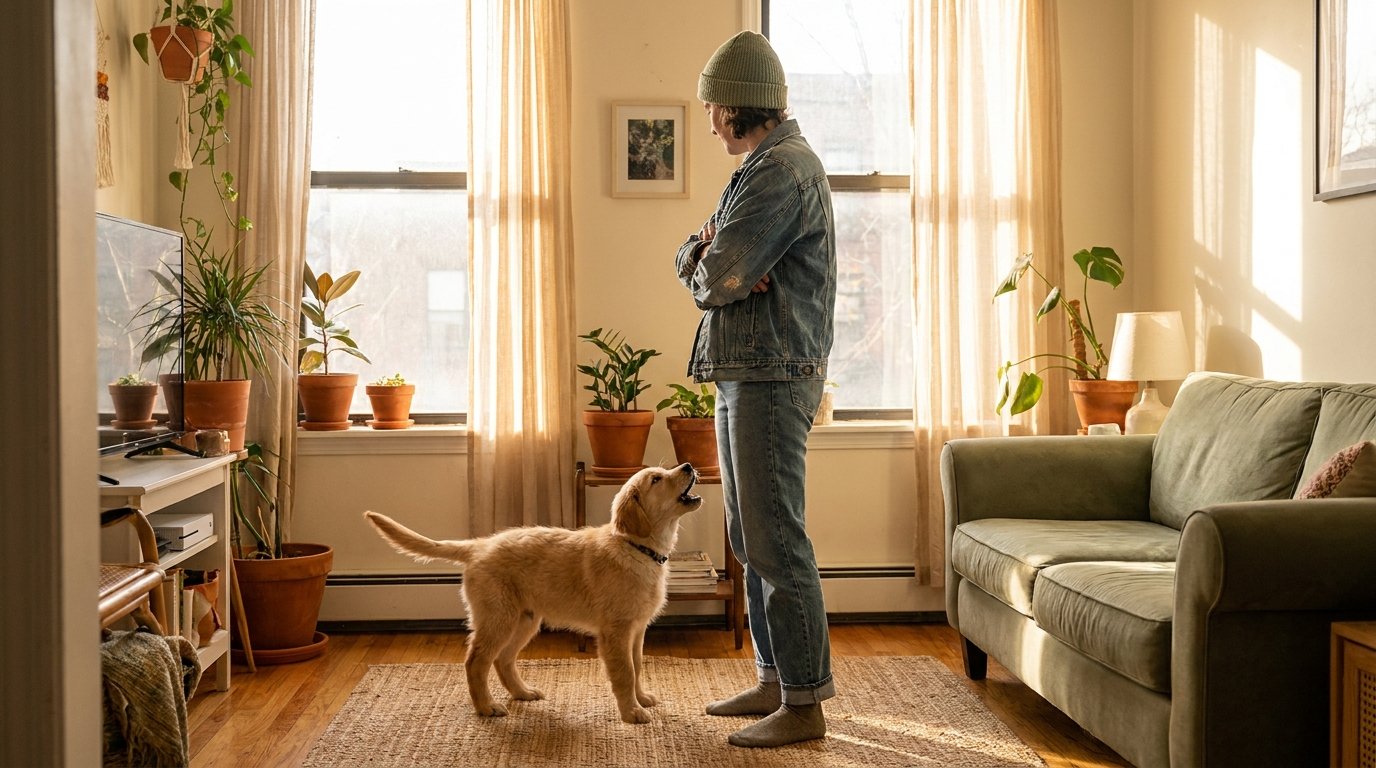
- Setting the baseline: The second your puppy’s front paws leave the floor to launch toward you, freeze instantly like a statue. Fold your arms across your chest, turn your head away, and avoid all eye contact.
- Rewarding stillness: The moment your puppy drops back down and all four paws hit the floor, immediately drop your gaze, soften your posture, and reward them with calm praise or a small training treat right at ground level.
How to Get Your Puppy to Stop Jumping Without Yelling

Stopping jumping without yelling relies on removing all reinforcement through the “turn-and-ignore” technique, combined with teaching an incompatible alternative behavior like a polite sit.
Yelling at an excited puppy often backfires because they interpret your raised, energetic voice as barking encouragement, matching your high arousal level rather than calming down.
- The zero-attention protocol: If turning your back isn’t enough, step entirely behind a baby gate or walk out of reach for five seconds the second a jump occurs. This teaches your puppy a hard physics lesson: jumping makes your human disappear completely, whereas standing quietly makes your human stay.
- Proactive redirection: Instead of waiting for the jump to happen, ask your puppy to “sit” before they even reach their launch threshold. When a puppy’s rear end is glued to the floor, they physically cannot leap upward into your face.
Best Way to Stop Puppy Jumping on Guests and Kids

Managing enthusiastic greetings with guests and children requires proactive management, a barrier leash, and pre-briefed visitors who understand how to withhold attention.
Greeting strangers is often where well-trained puppies suddenly regress because guests naturally squeal, bend down, and wave their hands—triggering an explosion of puppy excitement.
- The house-line strategy: During your puppy’s first thirty days in your home, keep a lightweight, handleless six-foot training leash attached to their collar whenever visitors arrive. If your puppy starts to launch toward a guest, you can gently step on the leash or guide them away before they ever make physical contact.
- Briefing your visitors: Before opening the door to guests or neighborhood kids, give them a thirty-second rule: “When you walk in, please ignore the puppy completely, keep your hands down by your sides, and wait until all four paws are on the floor before saying hello.”
What to Do When a Puppy Jumps Up and Bites

When an excited puppy combines jumping with frantic mouthing or biting, immediately cross your arms, become a statue, and redirect them to an approved chew toy once all four paws return to the ground.
Puppies use their mouths to explore and express over-arousal. When a jump turns into a nip at your clothing or wrists, pulling away fast or squealing can trigger their predatory chase instinct.
- Becoming a boring statue: Stand completely still with your arms locked tight against your torso. Do not pull your clothes away aggressively, as that mimics tug-of-war play.
- The post-landing reward: Wait out the puppy’s frenzy in absolute silence. The microsecond they drop their paws and step back, calmly offer a durable chew toy or ask for a simple sit before resuming interaction.
Mastering “Off” Cue Training Versus “Sit”

Teaching a reliable “off” cue gives you a verbal tool to signal your puppy to drop down, while pairing it with a seated position ensures long-term greeting manners.
While “sit” prevents jumping before it starts, the “off” cue is your emergency safety net for when a puppy has already started launching toward your knees.
- Introducing the cue: Hold a high-value treat at your puppy’s nose level while they are standing, and slowly lure them backward while saying “Off” in a calm, neutral voice. The moment their front paws drop back to the floor, mark with “Yes!” and deliver the treat.
- Consistency over correction: Never use “off” as an angry reprimand. Treat it like a gentle directional instruction, rewarding compliance instantly so your puppy learns that dropping down yields better treats than staying airborne.
Frequently Asked Questions (FAQ)

How can I get my puppy to stop jumping without yelling?
You can stop jumping without yelling by turning your back, folding your arms, withholding all attention until all four paws are on the floor, and rewarding calm behavior.
What is the naughtiest age for a puppy?
The peak naughtiness window typically occurs between 4 and 6 months of age, coinciding with intense adolescent development, boundary testing, and peak teething discomfort.
What commands stop dogs from jumping?
Teaching a rock-solid “Sit” command or a polite “Off” cue are the two most effective verbal commands to prevent and interrupt jumping behavior.
How do you get your dog to stop jumping on visitors?
Manage visitors by keeping your puppy on a short house-leash, instructing guests to ignore the dog entirely until all four paws are grounded, and rewarding calm greetings.
How do I stop my dog from jumping on you when excited?
Remove the reward of excitement by freezing, avoiding eye contact, and waiting for calm stillness before engaging with your dog.
How do I stop a puppy from jumping up and biting?
Stand like a statue with your arms crossed to eliminate movement, wait for all four paws to hit the floor, and immediately redirect their mouth onto an approved chew toy.
How do I get a dog to greet without jumping?
Practice controlled greeting setups with family members daily, asking for a seated position before opening a door or entering a room.
How to stop a dog from jumping on furniture?
Block access to couches using baby gates during early training, and reward your dog heavily whenever they settle quietly on their own designated dog bed.
Conclusion

Stopping a puppy from jumping on people requires patience, environmental management, and a strict commitment to consistency from every human in your home. By refusing to reward jumping with attention, enforcing the four-on-the-floor rule, and pre-teaching polite seated greetings, you will raise a well-mannered adult dog who greets everyone with grace.


“Alex is the go-to for anything practical — from picking the right harness to knowing when a puppy’s upset stomach needs a vet visit versus a little patience. Before joining Puppy Settled, she spent years working at a small-animal vet clinic and running a pet supply review blog on the side, which means every gear recommendation here has been tested (and every health tip double-checked). Alex owns a rescue mutt named Otis, who has personally ‘reviewed’ more chew toys and dog beds than any dog should probably need.”