
Puppy Feeding Schedule by Age: How Many Meals a Day and When to Cut Back
When you stand in your quiet kitchen at 6 a.m. and stare down at a plastic measuring cup while a ravenous eight-week-old puppy circles your ankles and whines like a tiny siren because their bowl remains entirely empty, you need to take a deep breath. You are certainly not failing as a dedicated pet parent, and figuring out proper canine nutrition does not require an advanced academic degree in animal science. Searching for an accurate puppy feeding schedule by age usually means you are actively dealing with a very specific, high-stakes moment of balancing frantic puppy hunger with the constant fear of overfeeding, underfeeding, or triggering an upset stomach right before a long workday.
When you transition a puppy from a breeder’s traditional weaning gruel to precise daily portions, you are taking one of the most critical steps in establishing their long-term lifelong health. By carefully understanding age-specific feeding frequencies, mastering accurate portion control, and tailoring feeding schedules to your puppy’s unique breed size, you can successfully establish a predictable, stress-free routine that lasts from eight weeks all the way to one full year of age.
Puppy Feeding Frequency by Age: Why Meal Spacing Matters

Puppies need to be fed multiple small meals a day rather than one or two large portions because their tiny stomachs cannot hold enough calories at once to support their rapid metabolic growth.
When an eight-week-old puppy arrives in your home, their digestive system is working at lightspeed. They are building bones, muscles, and neural pathways simultaneously, which requires a massive, steady influx of energy. If you try to feed a young puppy just two large meals a day, their stomach will stretch uncomfortably, leading to sluggishness, vomiting, or dangerously bloated digestion.
Spacing meals out evenly throughout the day keeps their blood sugar stable, prevents extreme hunger meltdowns, and gives their developing digestive tract a manageable stream of nutrients to process. This frequency also ties directly into your house-training routine, because what goes in must come out roughly 15 to 30 minutes later.
The Month-by-Month Puppy Feeding Schedule (8 Weeks to 12 Months)

A proper puppy feeding schedule progressively drops meal frequency as the dog matures—transitioning from four meals a day at eight weeks down to two adult meals by one year of age.
To take the guesswork out of your daily routine and make your meal planning effortless, use this age-by-age feeding frequency chart:
| Age Range | Meals Per Day | Approx. Feeding Times | Key Nutritional & Routine Focus |
| 8 to 12 Weeks | 4 Meals | 7:00 AM, 11:00 AM, 3:00 PM, 7:00 PM | Protects against hypoglycemia; matches infant gastric capacity; ties to frequent potty breaks. |
| 3 to 6 Months | 3 Meals | 7:00 AM, 12:00 PM, 6:00 PM | Expanding stomach capacity; supporting steady adolescent growth and high daily energy. |
| 6 to 12 Months | 2 Meals | 7:00 AM, 6:00 PM | Transitioning to standard adult rhythm; slowing metabolic rate; preventing midday sluggishness. |
- The large and giant breed exception: Giant-breed puppies (like Great Danes or Mastiffs) grow at an astronomical rate that requires carefully managed calcium-to-phosphorus ratios to prevent skeletal deformities. Always confirm exact caloric targets and transition timelines with your veterinarian.
How Much Should You Feed? Reading Food Labels and Calculating Portions

Calculating daily puppy food portions requires checking the caloric density guidelines on your specific puppy kibble bag, factoring in your dog’s projected adult weight, and adjusting based on body condition.
One of the biggest mistakes new owners make is blindly following the generic chart printed on the back of a dog food bag without monitoring their puppy’s actual physical shape. Dog food manufacturers often overestimate caloric needs, which can lead to rapid, unhealthy weight gain in less active puppies.
- The body condition check: Run your hands gently along your puppy’s ribcage. You should be able to feel their ribs easily under a thin layer of muscle without pressing hard, and you should see a visible waistline tuck when looking down from above. If your puppy feels like a smooth barrel, cut back slightly on portions; if their ribs protrude sharply, increase their daily intake.
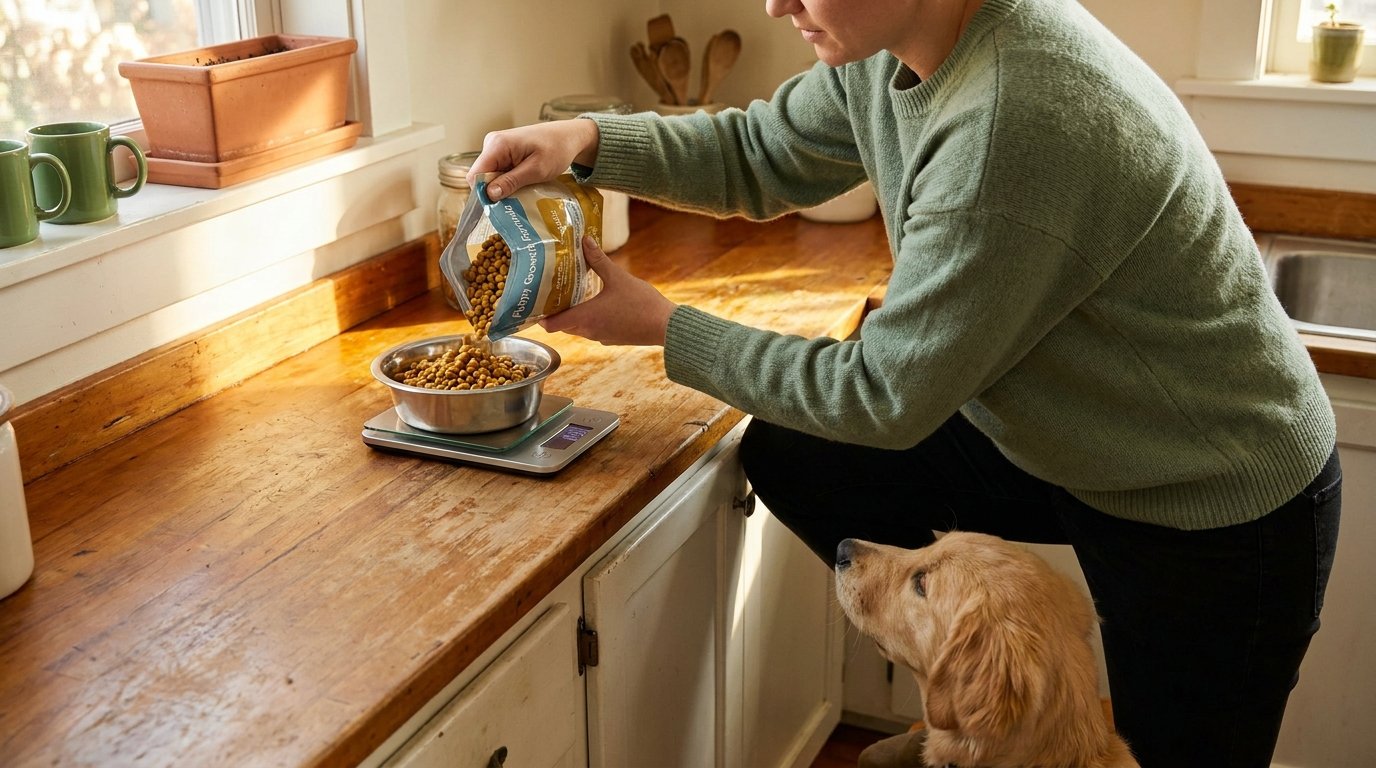
- Using food bags as a baseline: Use the manufacturer’s weight-based feeding guide as a starting estimate, divide that total daily volume across your scheduled meals, and weigh out portions on a digital kitchen food scale for true accuracy.
When and How to Switch Your Puppy From 3 Meals to 2 Meals

You should switch your puppy from 3 meals to 2 meals a day around six months of age, making the transition gradual by shifting midday calories into the morning and evening bowls.
Many owners wonder when the right moment arrives to drop the midday feeding, especially if they work outside the home or have a busy daily schedule. Cutting back too early—such as at three or four months—forces a tiny stomach to process too much food at once, while waiting past six months is unnecessary since their digestive tract can comfortably handle larger portions.
- The transition method: Over the course of a week, take half of your puppy’s midday meal and add it to their morning bowl, and take the other half and add it to their dinner bowl. This allows their metabolic system to adjust to the larger volume per sitting without causing digestive upset or vomiting.
How to Use Mealtimes for Training and Mental Enrichment

Turning a static food bowl into an interactive training tool helps burn mental energy, prevents gulping, and teaches impulse control during your puppy’s first months home.
Feeding your puppy exclusively out of a stainless steel bowl misses a golden opportunity for behavioral development. In a small apartment or busy household, mealtimes are your secret weapon for exhausting a high-energy puppy’s brain.
- Kibble as high-value currency: Measure out your puppy’s morning and afternoon meal portions and set them aside in a training pouch. Use those individual kibbles as rewards during name-group practice, crate entries, and leash-walking sessions.
- Slowing down fast eaters: If your puppy inhales their food in thirty seconds flat and hiccups afterward, ditch the bowl entirely. Serve meals inside a textured slow-feeder bowl, a rubber treat-dispensing toy, or a snuffle mat to engage their natural foraging instincts.
Transitioning From Puppy Food to Adult Maintenance Food

Transitioning a puppy from high-calorie puppy food to adult maintenance food typically occurs between 12 months for small breeds and 18 to 24 months for giant breeds, following a gradual 7-day mix.
As your puppy reaches physical maturity, their energy demands drop significantly. Continuing to feed a high-fat puppy formula past maturity can lead to rapid, unhealthy weight gain and put unnecessary stress on their joints.
- Timing the switch: Small-breed dogs reach skeletal maturity around 10 to 12 months, whereas large and giant breeds continue filling out well past their first year. Consult your vet to determine the exact milestone for your specific breed.
- The slow blend: Whenever you cross this nutritional threshold, never switch formulas overnight. Use a patient 7-day mixing ratio, blending 25% new adult food with 75% puppy food on day one, and scaling up every two days until the transition is complete.
Frequently Asked Questions (FAQ)

How many times a day should I feed my puppy?
Feed an 8-to-12-week-old puppy four meals a day, drop to three meals around 3 months, and transition to two meals a day by 6 months of age.
When should I switch my puppy from 3 meals to 2 meals?
You should switch your puppy from 3 meals to 2 meals a day around 6 months of age, once their digestive capacity has matured and their growth rate begins to stabilize.
How many meals should a 12-week-old puppy eat?
A 12-week-old puppy should eat four evenly spaced meals a day to support their rapid metabolism and prevent low blood sugar.
What is the feeding schedule for an 8-week-old puppy?
An 8-week-old puppy requires four meals a day spaced evenly throughout waking hours, typically timed around 7 a.m., 11 a.m., 3 p.m., and 7 p.m.
When do puppies go from 3 meals to 2 meals a day?
Puppies typically go from 3 meals to 2 meals a day right around their six-month milestone, blending the midday portion into their morning and evening servings.
How often should a 6-month-old puppy eat?
A 6-month-old puppy should eat two meals a day—one in the morning and one in the evening.
Conclusion

Establishing a predictable feeding schedule takes the guesswork out of early pet parenting. By matching your puppy’s meal frequency to their developmental age, measuring portions accurately, and turning meals into training opportunities, you set the stage for a healthy, well-mannered dog.


“Alex is the go-to for anything practical — from picking the right harness to knowing when a puppy’s upset stomach needs a vet visit versus a little patience. Before joining Puppy Settled, she spent years working at a small-animal vet clinic and running a pet supply review blog on the side, which means every gear recommendation here has been tested (and every health tip double-checked). Alex owns a rescue mutt named Otis, who has personally ‘reviewed’ more chew toys and dog beds than any dog should probably need.”