
A mixed-breed puppy sitting in a living room next to a wire dog crate, stainless steel bowl, and a folded green blanket.

The Ultimate New Puppy Essentials Checklist (Printable)

Picture this: You are standing in the middle of a big-box pet store. The cart is half-full, your wallet is already crying, and you are paralyzed by a wall of thirty different dog beds. If you are feeling a sudden wave of panic about bringing your furry best friend home, take a deep breath. You are not alone. Knowing exactly what to buy before day one can feel incredibly overwhelming.

That is exactly why I put together this new puppy essentials checklist. We are going to cut through the marketing noise and focus strictly on what you actually need to survive those chaotic, wonderful first few weeks, tailored to your specific living setup.

Executive Strategy: Keep It Simple, Start Small

A top-down view of basic dog supplies including a leash, collar, rubber toy, and treats neatly arranged on a wooden floor.
Focus on the daily zones of living: sleeping, eating, going potty, and safe play

Before you start adding every adorable squeaky toy to your digital cart, let’s talk strategy. The pet industry wants you to believe you need a fully furnished doggy nursery before your pup even crosses the threshold. The reality? Your puppy needs a secure space to sleep, a reliable way to go to the bathroom, and a few high-value items to keep their razor-sharp teeth off your baseboards.

This guide is structured into the distinct zones of your daily routine: sleeping, eating, potty training, and playing. Instead of a generic dump of items, we will look at how these essentials shift whether you are navigating leash-walks in a third-floor apartment or wrangling your pup in a fenced suburban yard.

Start with the absolute basics. You can always order the fancy extras once you learn your specific dog’s personality, size, and chewing habits. Grab a cup of coffee, prepare to download our new puppy checklist printable at the end of this post, and let’s get your home truly puppy-proofed and ready for arrival.

The Safe Zone: Choosing the Right Crate

A wire dog crate set up in a living room, showing an internal divider panel blocking off half the space.
A crate with a divider panel saves you money by growing alongside your puppy

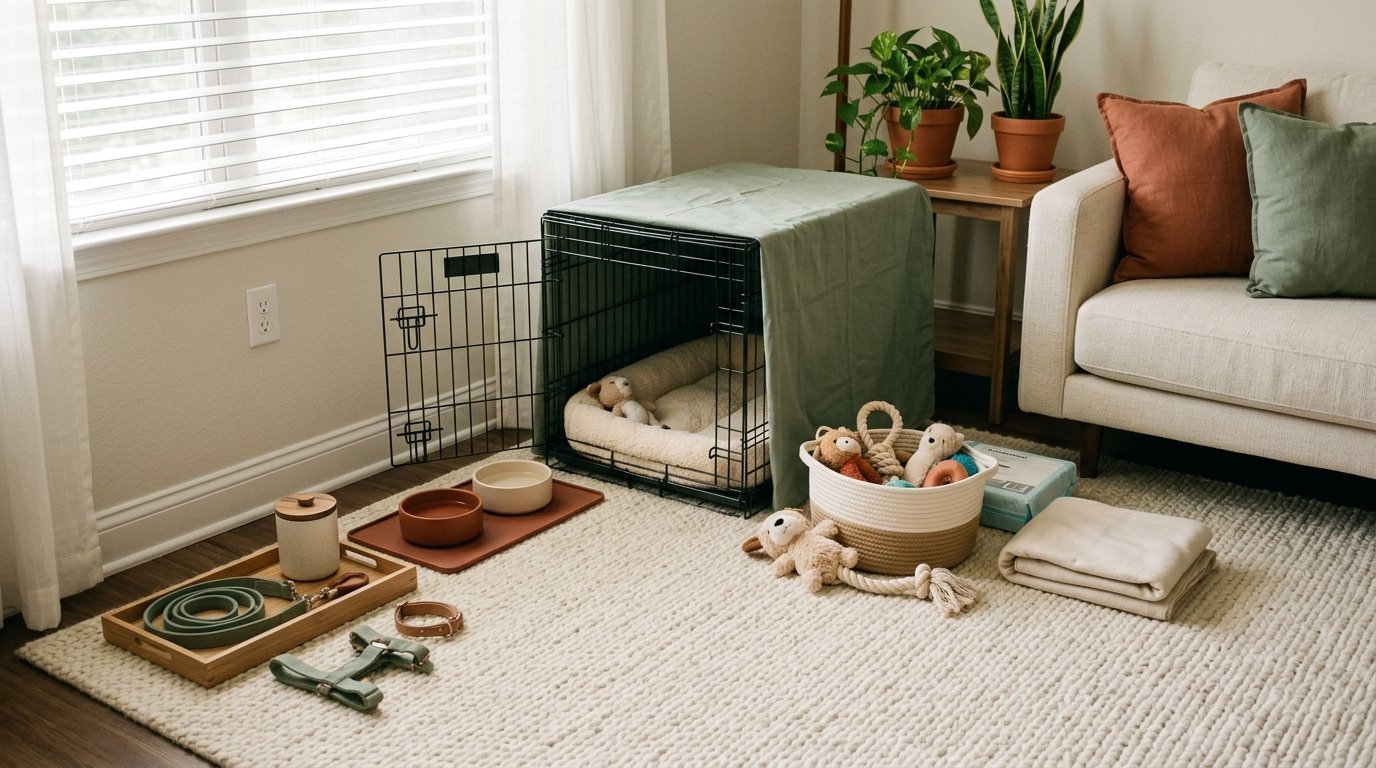
A crate is not a cage; it is your puppy’s den and your ultimate sanity-saver. For first-time owners, a wire crate with a divider panel is almost always the best investment.

Puppies grow incredibly fast. Instead of buying three different crates over the next year, a divider allows you to buy a crate that fits your dog’s adult size. You simply block off the extra space while they are small. If the space is too big, your puppy will sleep on one side and potty on the other.

  • Wire Crates: Great for airflow and visibility.
  • Plastic Crates: Good for travel and creating a dark, cave-like environment, but harder to resize.

Playpens for Work-From-Home Sanity

A metal dog playpen set up in a home office with a puppy sleeping inside on a green mat.
Exercise pens give your puppy room to stretch while keeping them safe during your Zoom calls

If you work from home, a crate alone isn’t going to cut it. You need a space where your puppy can safely play, stretch out, and stay out of trouble while you answer emails. Enter the exercise pen (or x-pen).

Think of an x-pen as a playpen for toddlers. It gives your puppy a designated safe zone that is larger than a crate but much smaller than free-roam of your living room.

  • Carpeted homes: Place a heavy-duty waterproof tarp or vinyl flooring scrap under the pen.
  • Open-concept homes: Use a freestanding metal pen to block off a specific corner.

Bedding That Actually Survives the First Month

A stack of neatly folded cream and green fleece blankets sitting on top of a laundry basket.
the expensive beds for now; cheap, washable fleece blankets are your best friend during potty training

Here is a hard truth about your first time puppy owner checklist: do not buy an expensive, plush, orthopedic dog bed right now. There is a 99% chance your puppy will either pee on it, chew a hole in it, or both.

During the potty-training and teething phases, keep bedding cheap, washable, and durable.

  • Fleece blankets: Cheap, easily washed in hot water, and replaceable.
  • Crate mats: Look for flat, water-resistant mats that fit the exact dimensions of your crate.
  • Old towels: Perfect for the first few weeks when accidents are daily occurrences.

Once your puppy is fully potty trained and past the destructive teething phase (usually around 8 to 10 months), you can invest in that gorgeous, aesthetic bolster bed. Until then, prioritize your washing machine’s sanity.

Potty Training Basics for Yard Owners

A leash and a set of metal dog training bells hanging on the handle of a back door looking out into a yard.
Keep a dedicated slip-leash right by the back door for those urgent midnight bathroom trips

If you have a house with a backyard, your potty training gear is fairly straightforward, but you still need the right tools to make midnight bathroom trips efficient.

You do not want to be fumbling for gear when your puppy wakes up whining at 2:00 AM. Keep a small basket right by your backdoor with these essentials:

  • A slip-lead leash: Faster to put on than a standard collar/leash combo when every second counts.
  • Poop bags and a yard scoop: Clean up immediately. [needs source] Leaving waste in the yard increases the risk of intestinal parasites.
  • A dedicated flashlight: For keeping an eye on them in the dark corner of the yard.

Potty Training Essentials for Apartment Living

A rectangular tray containing real grass sitting on an apartment balcony with city buildings in the background.
Real grass patches on a balcony can save apartment dwellers from exhausting midnight elevator rides

Apartment dwellers face a much steeper hill when it comes to potty training. Waiting for an elevator while holding a squirming, full-bladdered puppy is an extreme sport.

If you live in a high-rise or do not have a private, parvo-safe outdoor area, you need an indoor-to-outdoor transition plan.

  • Real grass patches: Subscription services deliver hydroponically grown grass patches to your balcony. This teaches the puppy to pee on grass, not soft fabric.
  • Pee pads: Use these only as a last resort or if you have zero balcony access. They can accidentally teach your dog that peeing on soft squares (like your rugs) is acceptable.
  • Sling carrier: Essential for carrying your unvaccinated puppy down crowded apartment hallways and elevators safely.

Cleaning Supplies for Inevitable Accidents

A bottle of pet stain enzyme cleaner, paper towels, and a blacklight flashlight resting on a light-colored carpet.
Standard carpet cleaner won’t work on pet accidents; you absolutely need an enzymatic formula

Accidents will happen. It is not a matter of if, but when. Regular household cleaners will not cut it when it comes to puppy urine.

Standard floor cleaners might mask the smell to your nose, but your puppy’s powerful sense of smell will still detect the uric acid. If they smell it, they will pee there again. You absolutely must use an enzymatic cleaner.

  • Enzymatic Sprays: These contain live enzymes that literally eat the bacteria causing the urine odor, permanently neutralizing the spot.
  • Paper towels: Buy these in bulk. You will use more than you think.
  • A blacklight flashlight: A cheap tool to find old, dried accidents on your carpets that you might have missed.

Food and Water Bowls (Why Material Matters)

Two stainless steel dog bowls, one with water and one with kibble, sitting on a mat on a kitchen floor
Stainless steel bowls are the safest, most hygienic option for feeding your new puppy

Walking down the bowl aisle, you will see plastic, ceramic, and stainless steel. Skip the plastic entirely. Plastic bowls can easily get scratched, harboring bacteria in the crevices that can cause doggy acne on your pup’s chin.

Ceramic is heavy and beautiful but breaks easily if a clumsy puppy knocks it over.

  • Stainless steel: The absolute gold standard. It is durable, dishwasher safe, and bacteria-resistant.
  • Heavy-bottomed bowls: Look for bowls with a wider base and a non-slip rubber ring on the bottom. Puppies love to step in their water bowls or push them across the kitchen floor.
  • Slow feeder bowls: If you are bringing home a breed known for inhaling their food (like a Labrador or Golden Retriever), grab a slow feeder to prevent choking and digestive issues.

High-Value Training Treats and Storage

A close up of a person wearing jeans with a green silicone dog treat pouch clipped to their waist.
A wearable treat pouch ensures you can reward good behavior the exact second it happens

You are going to be doing a lot of training in those first few weeks. Rewarding your puppy for going potty outside, going into their crate, and simply looking at you requires a massive arsenal of treats.

Skip the hard, crunchy biscuits. For training, you need treats that are small, soft, and highly aromatic.

  • Soft training treats: Look for pea-sized treats that can be swallowed instantly without chewing.
  • Treat pouches: Buy a wearable silicone or fabric treat pouch that clips to your waistband. Timing is everything in training; you need immediate access to rewards.
  • Single-ingredient options: Freeze-dried liver or plain boiled chicken are excellent high-value rewards for difficult tasks like crate training.

The Right Collar and ID Tags for Tiny Necks

A small green nylon dog collar with a metal bone-shaped tag resting on a light wooden table.
Keep their first collar lightweight, adjustable, and always attached to an engraved ID tag

Your puppy’s first collar is mostly for holding their ID tags and getting them used to the feeling of wearing something around their neck. It will not be the collar they wear into adulthood.

Buy an inexpensive, adjustable flat nylon collar with a sturdy buckle. Avoid slip collars, prong collars, or anything heavy for a young puppy.

  • The Two-Finger Rule: You should be able to slide exactly two fingers comfortably between the collar and your puppy’s neck. Check this weekly, as they grow astoundingly fast.
  • ID Tags: Have an ID tag engraved before you pick the puppy up. Include your dog’s name, your phone number, and your city/state.
  • Microchipping: While collars can fall off, a microchip is permanent. Ensure your vet schedules this during your first wellness visit.

Choosing a Leash (Skip the Retractable)

A person's hand holding the looped handle of a brown leather dog leash outdoors on a sidewalk.
A standard 6-foot leash gives you the control and safety that retractable leashes completely lack

There is one rule you must follow when buying your first leash: absolutely no retractable leashes.

Retractable leashes teach your puppy that pulling gets them where they want to go. Worse, if you drop the plastic handle, it will “chase” the puppy, terrifying them and potentially causing them to run into traffic. They also offer zero control if a stray dog approaches.

  • Standard 6-foot leash: This is the perfect length for neighborhood walks and basic training.
  • Materials: Nylon is cheap and durable, but a high-quality leather leash is softer on your hands and gets better with age.
  • Traffic handles: Look for a leash with a second loop near the clip. This allows you to quickly pull your puppy close to your leg when crossing streets or passing other dogs.

Harnesses for Safe Early Walks

A golden retriever puppy wearing a padded front-clip walking harness sitting on green grass.
A harness protects your puppy’s fragile throat and makes early leash-walking training much easier

While a collar holds their tags, a harness is much safer for walking a young, untrained puppy. Puppies have fragile tracheas. If they lunge at a squirrel or suddenly hit the end of the leash, a collar can cause serious throat damage.

A well-fitted harness distributes that pressure safely across their chest and shoulders.

  • Back-clip harnesses: Great for very young puppies just getting used to walking on a leash, offering comfort and freedom of movement.
  • Front-clip harnesses: The leash attaches at the chest. If your puppy starts pulling, the tension gently redirects their body back toward you. This is an incredible tool for teaching loose-leash walking.

Chew Toys for the Teething Phase

A terracotta-colored rubber dog chew toy sitting on a cream rug next to human slippers.
Provide plenty of safe, textured rubber toys to keep those needle-sharp teeth away from your shoes

Around 12 to 16 weeks of age, your puppy will begin losing their baby teeth. During this phase, their gums hurt, and their singular mission in life is to chew on anything that provides relief—including your hands, your furniture, and your shoes.

You must provide acceptable alternatives.

  • Firm rubber toys: Look for toys specifically designed for teething puppies. They are softer than adult rubber toys but firm enough to massage the gums.
  • Freezable toys: Keep a rotation of toys in your freezer. The cold provides incredible numbing relief for inflamed puppy gums.
  • Textured chews: Toys with nubs, ridges, and varied textures help work loose baby teeth out safely.

Never leave a puppy unsupervised with a chew toy. If they break a piece off, it immediately becomes a choking hazard.

Engagement Toys for Mental Exhaustion

A fabric snuffle mat on the floor being used by a puppy foraging for food.
Ten minutes of sniffing out kibble from a snuffle mat will exhaust a puppy faster than a long walk

Physical exercise is important, but mental stimulation is the secret weapon for a calm puppy. Ten minutes of sniffing and problem-solving will tire a puppy out faster than a twenty-minute walk.

Engagement toys force your puppy to use their brain to get their food.

  • Stuffable rubber cones: (Like a KONG). Stuff them with wet food, plain yogurt, or soaked kibble and freeze them overnight. This turns a 2-minute meal into a 30-minute quiet activity.
  • Snuffle mats: Fabric mats with deep folds where you hide dry kibble. Your puppy has to sniff and forage to find their dinner.
  • Lick mats: Textured silicone mats you can smear with peanut butter (ensure it is xylitol-free!). Licking is a naturally soothing behavior that lowers a dog’s heart rate.

Grooming Basics You Need on Day One

Puppy grooming supplies including shampoo, a brush, and a comb resting on a bathroom counter near a green towel.
Start touching your puppy’s paws and brushing them gently in the very first week

Even if you plan to use a professional groomer, you need basic grooming supplies at home. Getting your puppy comfortable with being brushed and handled is a critical part of their early socialization.

Your grooming kit will depend entirely on your dog’s breed.

  • Short-haired breeds: A simple rubber curry brush helps remove loose hair and dirt while feeling like a massage.
  • Long-haired or Doodle breeds: You absolutely need a high-quality slicker brush and a metal greyhound comb. You must comb all the way down to the skin to prevent painful matting.
  • Puppy shampoo: Adult dog shampoo can dry out a puppy’s sensitive skin. Buy a tearless, gentle puppy formula.

Start touching their paws, ears, and tail daily to prepare them for future vet and grooming visits.

Health and First Aid Necessities

A clear bin containing pet first aid supplies like styptic powder and a vet records folder on a kitchen counter.
A basic first-aid kit prevents minor scrapes from turning into panicked emergency vet visits

Puppies are clumsy, curious, and prone to minor scrapes. Having a basic first aid kit ready prevents a minor issue from turning into a panicked midnight run to the emergency vet.

Keep a dedicated pouch in your bathroom or kitchen with a few specific items.

  • Styptic powder: If you accidentally cut their nail too short during a trim, this powder instantly stops the bleeding.
  • Tick removal tool: Essential if you live near wooded areas or tall grass.
  • Dog-safe wound spray: A gentle antimicrobial spray for minor scrapes (never use human hydrogen peroxide on dogs unless directed by a vet).

Keep a physical folder with your puppy’s vaccination records, and stick your local 24/7 emergency vet’s phone number and address directly on your refrigerator.

Puppy-Proofing Gear for Your Home

A white metal baby gate installed across a hallway inside a house.
Management is the secret to good training; use baby gates to block access to carpeted rooms

Puppy-proofing is about managing the environment so your puppy simply doesn’t have the opportunity to make bad choices. Get down on your hands and knees and look at your house from their eye level.

  • Baby gates: These are your best friends. Block off carpeted rooms, stairs, and areas with heavy foot traffic until the puppy is reliably potty trained.
  • Cord protectors: Puppies love the texture of electrical cords. Slide PVC cord covers over exposed TV and lamp wires.
  • Bitter apple spray: A taste deterrent you can spray on furniture legs or baseboards. It doesn’t work for every dog, but for many, the bitter taste immediately stops the chewing.
  • Secure trash cans: Invest in heavy kitchen trash cans with locking lids.

FAQ: What Do You Need for a New Puppy?

What do you need for a new puppy on the very first night?

Keep it minimal. You need a secure crate, a cheap fleece blanket, a flat collar, a leash, one bag of their current food, two stainless steel bowls, and a safe chew toy. Do not overwhelm them with too many new items on day one.

Is a new puppy checklist printable actually helpful?

Absolutely. Printing a physical checklist allows you to track deliveries, budget expenses, and visually see what is missing before pickup day. It helps clear the mental clutter.

How much should I budget for first-time puppy essentials?

Excluding vet bills, expect to spend between $200 and $500 on the initial setup (crate, playpen, bowls, leash, harness, basics). Quality crates and x-pens take up the bulk of this budget, but they are one-time investments.

Should I buy adult-sized gear immediately?

Only for the crate (if it has a divider). Buy cheap, appropriately sized collars, harnesses, and beds for the puppy phase, as they will outgrow or destroy them within a few months.

Conclusion

Bringing home a new dog is thrilling, exhausting, and wonderfully chaotic. By sticking to this new puppy essentials checklist, you are setting up a secure, structured environment that helps both you and your pup transition smoothly. Remember, they do not care about having the most expensive aesthetic toys; they just want to feel safe, loved, and properly guided in their new home.

See also  Traveling With a Puppy Without a Crate: What to Use Instead

Leave a Reply

Your email address will not be published. Required fields are marked *